Custom Tallow Skincare Formulation | Grass-Fed Essentials
CUSTOM TALLOW SKINCARE FORMULATION

Develop an original product around a commercial brief, not a collection of ingredients.

Custom formulation turns a defined product objective into an original formula, manufacturing process and commercial plan. The work progresses through feasibility review, ingredient selection, samples, refinement, packaging assessment, scale up, testing and production.
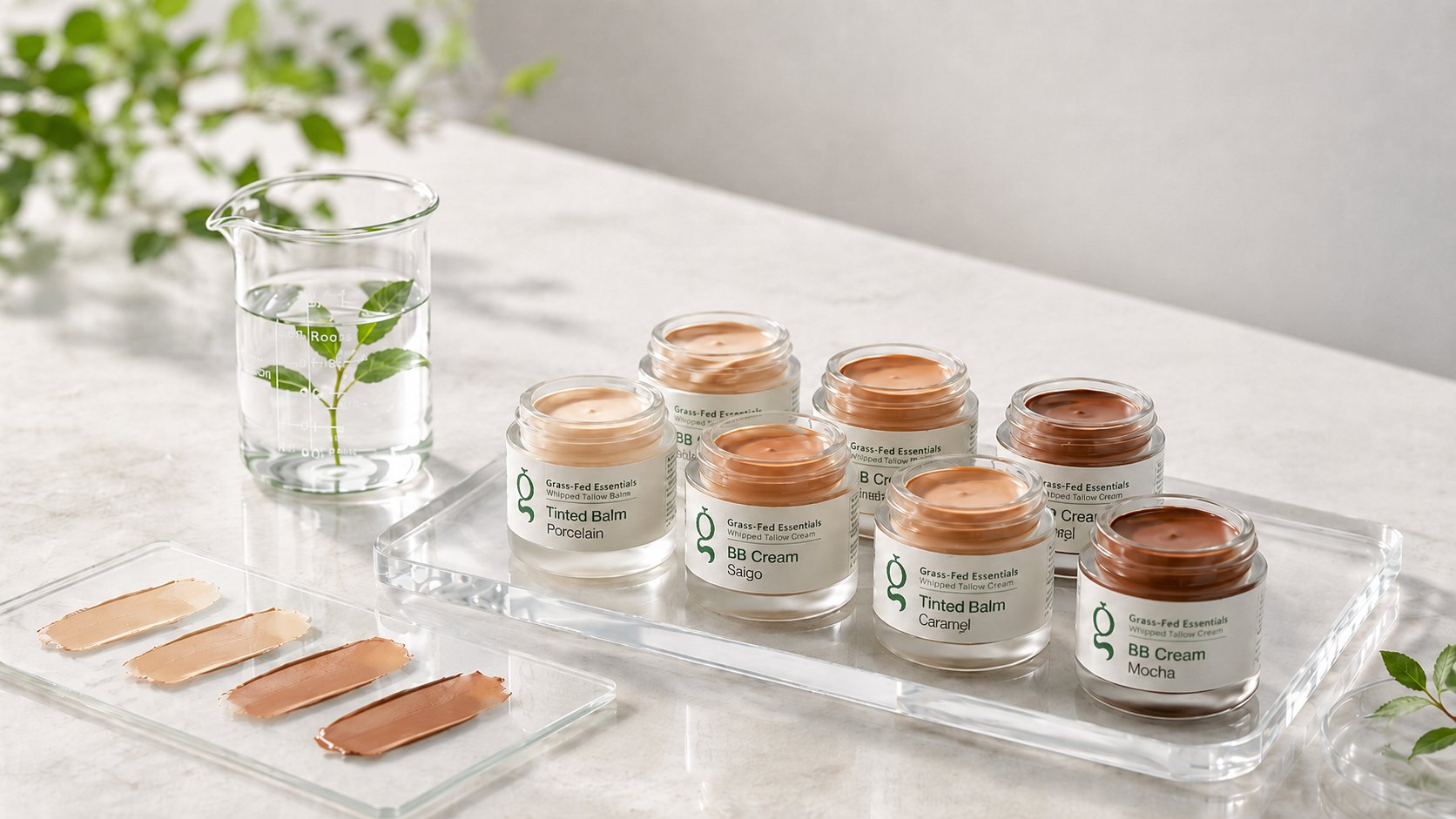
Custom tinted balm and BB cream shade range with drawdown swatches

The brief is the first formulation tool.

A useful brief explains what the product must do for the customer, how it should feel, where it will be sold, what it may claim, how it will be packaged and what the commercial model can support.

Beginning with a long ingredient wish list often creates conflict between texture, stability, claims, cost, packaging and production. Beginning with a clear product objective allows ingredients to be selected for a reason.

Custom does not mean adding everything. It means making every ingredient and every process decision answer the brief.
WHAT A USEFUL BRIEF CONTAINS
Intended customer and use
Product format and benchmark
Desired texture, finish and application
Ingredients to include and exclude
Packaging direction
Destination market
Intended claims and required evidence
Target retail position and manufacturing cost
Expected order volume
Launch objective
FORMULATE THE WHOLE PRODUCT

The formula, process, packaging and claim must agree.

THE MATERIAL SYSTEM
Tallow, carrier oils, waxes, powders, extracts, actives, antioxidants, fragrance and other components must work together at the selected percentages.
THE SENSORY SYSTEM
Firmness, glide, absorption, residue, scent, color and appearance must fit the intended customer and use.
THE MANUFACTURING SYSTEM
The order of addition, temperatures, mixing, cooling, filling and scale must be capable of producing the approved result consistently.
THE PACKAGING SYSTEM
The product must fill, set, dispense, travel and remain usable in the selected component.
THE EVIDENCE SYSTEM
The intended claims, label, specifications, tests and records must be appropriate to the product and destination market.
DEVELOPMENT STAGES

A structured sequence from concept to commercial manufacture.

01
PRODUCT BRIEF
Define the customer, product objective, format, sensory target, ingredients, exclusions, packaging, market, claims, cost and volume.
02
FEASIBILITY REVIEW
Identify conflicts, missing information, ingredient availability, regulatory constraints, testing needs and commercial risks.
03
FORMULA DIRECTION
Select a rational ingredient and process strategy that answers the brief.
04
SAMPLE DEVELOPMENT
Prepare samples that test the agreed direction rather than exploring without a decision framework.
05
CLIENT EVALUATION
Collect specific feedback on texture, application, absorption, scent, appearance, performance and packaging interaction.
06
FORMULA REFINEMENT
Adjust the formula against the approved feedback and confirm the target product.
07
PACKAGING REVIEW
Assess the selected component, fill method, closure, label area, expected transport and customer use.
08
SCALE UP
Confirm that the formula and process can be reproduced with commercial equipment, batch size and filling conditions.
09
TESTING AND DOCUMENTATION PLAN
Define the specifications, tests, records, claims support and responsibilities required before or around commercial launch.
10
COMMERCIAL MANUFACTURE
Manufacture the approved product under the defined process and complete the agreed batch, packaging and delivery records.
Development cost and timing are determined by complexity, sample rounds, ingredient sourcing, packaging, testing, claims and client response time. They are defined in the written proposal.
NATURAL INTEGRITY WITH TECHNICAL DISCIPLINE

A natural product should not be made less natural in the name of control. It should be made more deliberate.

Our objective is to protect the useful character of the tallow and selected oils while designing a formula and process that can meet the agreed sensory, packaging and commercial requirements. We avoid unnecessary complexity, but we do not use simplicity as an excuse to ignore stability, oxidation, contamination, repeatability or claims.

FORMULA OWNERSHIP

Ownership must be written before development creates value.

The development agreement should define formula ownership, manufacturing rights, license rights, exclusivity, confidentiality, transfer rights, process information and the effect of unpaid amounts or termination. The phrase custom formulation does not settle those issues by itself.

Bring us a clear product ambition and the commercial facts around it.

Tell us who the product is for, how it should feel, what it should contain, what it must avoid, how it will be packaged, where it will be sold and what volume the business expects to support.

FREQUENTLY ASKED

Common questions about custom formulation.

How many sample rounds does development take?
The number of rounds depends on the clarity of the brief, the ambition of the product and the feedback received. The written scope should define the included rounds and the cost or process for additional work.
Do I own the finished formula?
Ownership is determined by the signed development agreement. Formula ownership, license rights, manufacturing rights, exclusivity and transfer rights should be defined before work begins.
What does custom development cost?
Development is priced against the brief. Complexity, ingredient sourcing, sample rounds, packaging, testing, claims, documentation and scale up all affect the scope. A reliable price cannot be produced from a product name alone.
Can you replicate an existing product?
An existing product may be used as a sensory or positioning benchmark. Grass-Fed Essentials develops an original formula direction and does not copy proprietary formula information or present another company product as its own work.
Can I bring an existing formula?
Yes. The formula will be reviewed for ingredient availability, manufacturability, process, packaging, scale up, claims, documentation and commercial fit before it is accepted for development or production.
When should packaging be selected?
Packaging direction should be considered early because the component can affect viscosity, filling, cooling, dispensing, leakage, label area, freight and customer use. Final packaging should be confirmed before commercial production.